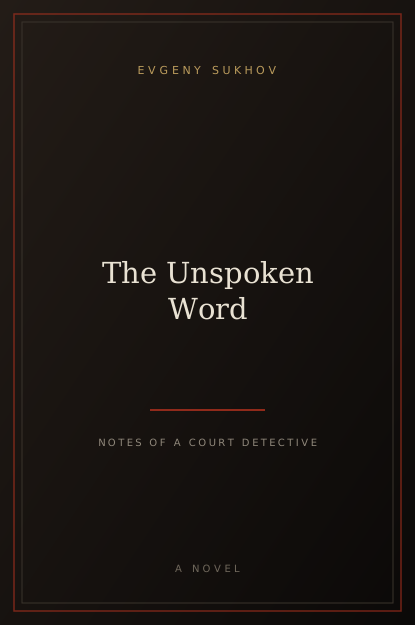
NewThe Unspoken Word2026
Evgeny Sukhov
RUEN

Notes

A Writer's Path

Twenty-two instalments on how it all began: the newspaper serial “I Am a Thief-in-Law”, the first books, publishers, and the work on the novels.

Part 1

Part 1

After the newspaper publication of I Am a Thief-in-Law in 1993-1994, I naturally wanted the novel to come out as a separate book. And then I received an offer from the Kazan publishing house Renome to print it. I didn't think long, and soon we signed a contract. A couple of days later an offer arrived from Moscow to take the book. But I refused, despite long persuasion, saying that the contract had already been signed. Soon the book came out in a print run of 20,000 copies. I was offered a choice: take the money or take 1,000 copies of the print run. This time I did think for a long while, but the director convinced me that it would be better that way: I could set the price myself and increase my earnings. For a penniless Candidate of Sciences, that was a good lure.

In the end he turned out to be right. With the help of friends I delivered my copies to nearly every bookshop in Tatarstan. And then I collected my earnings.

Acquaintances were amazed: "What's going on?! Wherever you go, your book is there. They even sell it at Sabantuy!"

Incidentally, it was with that fee that I bought my first car, a two-year-old Lada Four.

And when I went to Moscow to the Armada publishing house to sign a contract for two books at once, the editor asked me:

"I Am a Thief-in-Law, by any chance, isn't that your book?"

"Mine. How do you know about it?"

"They run ads for your book on the radio every half hour!"

I should note that in all that time nobody in the publishing houses ever asked whether I was a member of the Writers' Union or not... What matters is the book, a product that can be sold. The guys there are down-to-earth, and you can't talk them round.

Next came the novel The Safecracker, about the Moscow criminal investigation department. But this novel, which I love very much, was included in the I Am a Thief-in-Law series.

Little by little the series turned into a brand. Incidentally, it is still being published, now by Eksmo. In total it is already 23 years old, though it now has many authors. Remarkably, it doesn't look elderly.

Original on Instagram ↗

↑→

Part 2

Part 2

After the newspaper publication of I Am a Thief-in-Law in 1993-1994, I naturally wanted the novel to come out as a separate book. And then I received an offer from the Kazan publishing house Renome to print it. I didn't think long, and soon we signed a contract. A couple of days later an offer arrived from Moscow to take the book. But I refused, despite long persuasion, saying that the contract had already been signed. Soon the book came out in a print run of 20,000 copies. I was offered a choice: take the money or take 1,000 copies of the print run. This time I did think for a long while, but the director convinced me that it would be better that way: I could set the price myself and increase my earnings. For a penniless Candidate of Sciences, that was a good lure.

In the end he turned out to be right. With the help of friends I delivered my copies to nearly every bookshop in Tatarstan. And then I collected my earnings.

Acquaintances were amazed: "What's going on?! Wherever you go, your book is there. They even sell it at Sabantuy!"

Incidentally, it was with that fee that I bought my first car, a two-year-old Lada Four.

And when I went to Moscow to the Armada publishing house to sign a contract for two books at once, the editor asked me:

"I Am a Thief-in-Law, by any chance, isn't that your book?"

"Mine. How do you know about it?"

"They run ads for your book on the radio every half hour!"

I should note that in all that time nobody in the publishing houses ever asked whether I was a member of the Writers' Union or not... What matters is the book, a product that can be sold. The guys there are down-to-earth, and you can't talk them round.

Next came the novel The Safecracker, about the Moscow criminal investigation department. But this novel, which I love very much, was included in the I Am a Thief-in-Law series.

Little by little the series turned into a brand. Incidentally, it is still being published, now by Eksmo. In total it is already 23 years old, though it now has many authors. Remarkably, it doesn't look elderly.

Original on Instagram ↗

←↑→

Part 3

Part 3

1994. Three books published. I feel almost happy. My dream of becoming a writer is slowly coming true.

We swapped out our two-room Khrushchyovka flat in an exchange. It turned out well. My brother and I each got a one-room flat. Mine is closer to the centre. There are a couple of drawbacks: no renovation to speak of, and a cracked toilet, though at least it doesn't leak. I need to find money to fix both problems. On an associate professor's salary you can't even buy underpants. I have to think of something.

Every day they drop the newspaper Kris into my mailbox, which is noticeably irritating. I'm finishing the novel The Overseer, which in my opinion is a strong piece of work. You can't take it to Armada, they specialize in historical novels. But it has to be published. Only where?

Again this damned newspaper Kris in the mailbox, with its print run of 100,000! They could bring something more useful, instead of nothing but ads and horoscopes. I read neither. Suddenly a thought struck me: what if I took the novel The Overseer to the Kris editorial office? Then my novel would enter every home in Kazan. Almost every family would look through it or read it!

I looked up the address of the editorial office. Aha, also in the centre, ten minutes' walk from me. I took the printed manuscript and went. They received me warmly; it turned out they had already heard of me. I gave the novel to the editor-in-chief, she passed it to her deputy, who said a decision would be made in about three days. For some reason I was sure everything would be fine. It's a strong piece, after all!

I came to the editorial office on the appointed day. I asked how the novel was. They told me everything was in order and it would come out next week. We settled the fee right there, and they paid it to me without delay. I should have used that money for a partial renovation, to replace the toilet... Though to hell with it, it doesn't leak anyway! I'll rather buy spare parts for the car.

The following week the newspaper Kris came out with the first chapter of my novel. Look at that, they even made some kind of illustration! Looks not bad at all...

Now I absolutely love this newspaper! I'm ready to read even the classified ads in it. I'm gradually getting used to horoscopes. I even started reading the one for my sign. True, it promises me some kind of trouble. What could that mean?

To be continued in the next issue.

Original on Instagram ↗

←↑→

Part 4

Part 4

Riding on a train, writing my little stories...

1995-1996. By chance on Lobachevskogo Street I ran into V. Korchagin. In his day he taught us Geochemistry and Mineralogy. Later he was head of the geological field practice in the Southern Urals. He gave me an A in Geochemistry, and in Mineralogy I got a pass automatically. I love those teachers who don't torment me with exams. He stopped me and asked how I was doing.

Four books had come out. Two of them were published by Armada.

As it happened, I had one of the books published in Moscow with me. I showed him the book. Korchagin, who was prone to bursts of enthusiasm, said:

"How thick it is, and with a dust jacket, too! Zhenya, don't you want to join the Writers' Union?"

"I don't know, somehow..." "Come on, come on, join! You'll manage. I'll write you a recommendation. Bring all your published books. Book and magazine publications, and we'll consider your candidacy at the nearest board meeting. Agreed?"

"All right."

A few days later I met Dias Valeyev.

"Are you joining the Union?"

"Yes."

"I'll write you a recommendation."

A few days later I brought Korchagin my publications, and a couple of weeks after that I had to go to the board meeting and talk about myself and my work. And answer questions.

The appointed day came. As it turned out, Elena Burundukovskaya was being admitted along with me. I was meeting her for the first time. For some reason I had imagined her as a small, fragile girl who writes poetry and plays the violin. I saw a tall, interesting young woman.

In conversation she said that her application documents had been lying there for several years.

Original on Instagram ↗

←↑→

Part 5

Part 5

Before the meeting of the Writers' Union board I met Batulla. I gave him my book about the first Kazan khan. Batulla somehow reminds me of Grandfather Hamid from my childhood on Malaya Krasnaya. At least in appearance.

Both of Hamid's hands had been maimed in the war. On the right he was missing three fingers, on the left all of them. He loved coming to our yard to play dominoes. He would lay one tile at a time on his left palm, and if he drew a "baian" or a "blank", he would always turn it over. Nobody peeked into his palms, and he always took the tiles slowly so as not to drop them on the ground. Nobody hurried him. Often I stood beside him and helped him take the dominoes from his palm. We loved him, he was kind to us. He was about fifty then, but to us eleven-year-olds he looked like Koschei the Deathless's contemporary. He could get angry when we ran across the roofs and flew our kite (one of our favourite pastimes) and often thundered right above his head. He wasn't afraid that we might sell him his ceiling; he was afraid that we might fall through and cripple ourselves.

At the board meeting they asked me several questions. It was interesting to answer. The first question was asked by Tufan Minullin, whom I had known before and with whom I had taken part in the historical story competition of the magazine Idel. He took first place, I took third. Later, during the feast, he treated us to meat, saying it came from his farm. Apparently, by spring the playwright Tufan Minullin is reborn as a collective farmer.

That's it, I was accepted. Now I'm a member of the Writers' Union. Did something change in me? Probably not. I have to keep working... And this book is about the work of the MUR (Moscow criminal investigation department). The title is somewhat incorrect. I think it never reached readers who are interested in investigations.

To be continued.

Original on Instagram ↗

←↑→

Part 6

Part 6

Time passes, I write historical novels bit by bit, fully confident that they will be published. I do scholarly work, publishing articles. I started thinking about a doctoral dissertation. And then one day a bearded young man knocked on the door of my flat on Tatarstan Street, where I lived at the time. Introducing himself, he said he was the director of the Kazan book association "AST-Press", and that S. Derevyanko, the director of the publishing house, would like to sign a contract with me for the publication of the book I Am a Thief-in-Law. I agreed and, taking the publisher's address from him, went to Moscow. The publishing house was not far from Kazansky Station, which suited me very well, in a large building, occupying two floors.

I ran into the publisher's director at the doors in the corridor. I instantly realized it was him; he paused, looked at me closely and asked:

"Are you Evgeny Sukhov?"

"Yes."

We went into his spacious office. I was received warmly: they brought tea and biscuits, and I heard kind words.

Derevyanko was big and looked likeable. You can't take that away from him. He proposed to publish the book I Am a Thief-in-Law. I said I didn't object, but the rights still belonged to the Renome publishing house. He promised to come to terms with the previous publisher so that they wouldn't obstruct the publication. And he asked me to bring the old contract with Renome. More often a publisher asks for an old contract not to help the author but to avoid paying more. After some hesitation I decided to bring the contract; I was always for clean relationships. After quite a long conversation we found we had a lot in common. I confess, I liked Derevyanko after our first meeting. But I never thought that his friendly embrace could resemble a noose. That is exactly how a python strangles its victim. He suggested I write a sequel to the novel, and in a very short time; we even signed a preliminary contract, and he handed me some advance against a receipt.

I considered the book I Am a Thief-in-Law finished; for me the writing and the emotional turmoil were a turned page, but the offer was tempting. The upcoming work didn't frighten me, on the contrary, it invigorated me; after all, I'm a writer and I will certainly write a good piece. I just had to sit down and think hard.

To be continued: The Overseer of Russia, a book about a former SMERSH man.

Original on Instagram ↗

←↑→

Part 7

Part 7

I began writing the book I Am a Thief-in-Law not from scratch. I already had groundwork. For example, my novel The Overseer had come out in the newspaper Kris, and I wanted to use it. Which was quite logical: different audiences, there it was a newspaper, here it would be a book. I could strengthen some places, add episodes in others, make the dialogues more dynamic. And then the book had to be tied to the main hero, Varyag.

After thinking, I decided to put him in an American prison, where a thief would have to survive amid racial discrimination.

The book turned out voluminous, more than six hundred pages, and dynamic; in essence, it contained two books.

In due time I brought the book to the AST-Press publishing house and went home. After a while I spoke with the director by phone, who said I should come and talk about the book. They even promised to pay for the trip. Strangely, no talk of a contract came up for some reason. So what was going on? What was the reason? The editors had had enough time to read the book too.

I wasn't worried about the content; despite the rush, it was well written and contained rich material.

I didn't go to the publishing house right away; first I stopped by my aunt's, who lived in Moscow, and from her place I came to the meeting.

Right at the entrance the guard told me:

"They've already asked five times whether you've come yet."

I went up to the publishing house and met the general director Derevyanko, who held out a folder to me and said:

"Here is your book, we've corrected a few things here, you tell me how you like it. Whether the editors pleased you or not. We're even giving you a separate room so that nobody disturbs you."

What caught my eye at once was that the folder handed to me was considerably thinner than the one I had brought. About half as thick!

Which I said right away.

"Don't rush to judge, read it first. What didn't make it in can be used in another novel."

I read every page with irritation: there were inappropriate edits, annoying cuts. The person who had taken up the editing knew absolutely nothing about the subject. The novel was ruined!

When we met again about three hours later, I said frankly: I didn't like it; what came out was some kind of castrated novel. Where are the metaphors, the similes and the other embellishments?

Original on Instagram ↗

←↑→

Part 8

Part 8

After a short while the director of the Kazan bookshop "AST-Press", Valera, came to see me and asked me to call the publishing house. I explained to him that I wouldn't call, because the director wants to be a co-author, had cut the text in half, and his proposal regarding the fee didn't suit me. But Valera was insistent, and I decided to call. Could it be that they wanted to offer something new?

At my new place I had no telephone, so I went to the post office. "So, what have you decided?" the director asked at once.

"This isn't a scholarly article, it's a book, and co-authorship has no place here."

The conversation led nowhere. Derevyanko still insisted on co-authorship, and I had no choice but to explain clearly that I would not work with the AST-Press publishing house. At all!

To be continued in the next issue.

And this is a two-volume work in which there is everything: a dynamic plot, intrigue. It is a book about a cleaner whom FSB officers are trying to identify.

Original on Instagram ↗

←↑→

Part 9

Part 9

I had already said goodbye to the AST-Press publishing house and wasn't going to bring them any books. At that time I was writing the novel The Safecracker, about the confrontation between the Moscow criminal investigation department and a brilliant safe-breaker.

The work went well, which considerably lifted my mood. I started to think about where to take the novel once it was finished.

And then S. Derevyanko made an unexpected move. I should say that in the following years, too, he amazed me with his unexpected decisions. It might seem only at first glance that his decisions were sometimes extremely ill-considered and doomed to fail from the start. But in reality every step of his was carefully verified, weighed to the utmost and even, despite all the trampling of authors' rights and outright theft, legally justified. True, here he relied largely on a judge who was his person, and on the cumbersomeness of the judicial machine with its counterclaims, endless hearings, attaching of additional papers to the case and other procedures.

Evidently he plays chess rather well; one could feel an analytical mind.

Valera came to see me once and said that Derevyanko wanted to meet with me. I answered him:

"I won't go to him. As far as I'm concerned, I'm finished with that publishing house."

"No, this is different, he'll come to you, here, to Kazan."

That was a strong move on his part. Such gestures should be appreciated. I couldn't refuse to receive him: it would have been neither Christian nor humane.

For some time I thought about what to answer, how to react to such news; Valera waited patiently for a reply, and then I said:

"All right. Let him come."

Valera immediately named the day and hour when he was to arrive.

Hm, it turns out to be the day after tomorrow. He would come to me straight from the train.

Be that as it may, a guest has to be received properly. Let him know I don't chew only black bread.

I got everything suitable for the coming meeting so that the table wouldn't be poor, I

sent my wife and our small son to my mother-in-law's and started waiting.

The doorbell rings. Here come the guests..... To be continued in the next issue.

This two-volume work is devoted to the theft of the millennium. The theft of the Mona Lisa from the Louvre. In the book I suggested that in the Louvre there is a copy in place of the real painting.

Original on Instagram ↗

←↑→

Part 10

Part 10

Derevyanko arrived accompanied by Valera.

In the narrow hallway of the small flat, their large bodies made it completely cramped. We greeted each other in a friendly way, looking into each other's eyes. Derevyanko handed me a package. It was smoked eel; I set the fish aside to slice later.

We went into the tight little kitchen of the Khrushchyovka, where there was just enough room for the three of us. I put out my own spread on the table: meat, cold cuts, fruit. They were people fresh off the road and surely hungry.

The tension of the first minutes vanished as soon as we picked up our forks.

"Let's continue our cooperation," said Sergey.

"You want to be a co-author, and that doesn't suit me."

"There will be no co-authorship, I promise. I'm preparing a serious project that involves many people and big money. You will be one of the key figures. We'll be partners. Do you know how we found you?"

"No."

"My wife saw your book I Am a Thief-in-Law at the market, read it and advised me to read it. I read it, and we decided to offer you cooperation. You know, I've been in this business a long time; I was one of those who set up the AST publishing house, there were three of us. That's an abbreviation from the first letters of our names: S is my name, Sergey, and T is my wife's name, Tatyana. Later my wife and I created our own publishing house. We thought for a long time before starting to cooperate with you. We tried with others, but it didn't work out. You can't imagine how many writers have gone through us. And none of them is right! Just recently two more came along. They seem to write not badly, but you close the page and can't understand what they wrote. And you have something others don't. Let's forget all our disagreements and continue the project, which is already beginning to pick up serious momentum."

"I'm not against serious projects."

"Let's sign a contract right away, say, for three books. But they need to be written quickly."

"All right. Only I would like nobody to interfere with the content of the books. You cut the second book in half."

"We won't interfere. Except maybe editorial corrections. The print runs will be large, you'll earn well. I promise I won't cheat you and will pay the promised fee for every release."

Valera sat off to one side and only listened tactfully to our conversation.

Original on Instagram ↗

←↑→

Part 11

Part 11

Work on the books went well. I knew what to write about and had built a strict sequence, so a fairly complete picture formed in my head.

The manuscripts turned out quite voluminous, five hundred pages each. The publishing house was in a hurry too, so a quick way of handing over the written pages was set up: I gave fragments of the manuscript to train conductors, called the publishing house and said which carriage I had handed it to, and in Moscow the manuscript was picked up and passed to S. Derevyanko.

A fairly large volume was written, in my opinion enough for five books! Sometimes I phoned S. Derevyanko, and he asked me to write a few more chapters, which I did.

There were also times when he would invite me to Moscow and say:

"Things are going fine. The books will be out soon, but certain episodes need to be fleshed out. In our view this will strengthen the book. I can book a hotel for you. How much time do you need to write a hundred and fifty pages?"

I answered him:

"No need for a hotel, I'll stay with relatives. It's more convenient for me. I'll write the needed volume in a few days. I know what to write."

"Good, as soon as you've written it, let us know right away. You don't have to type it up, let's not lose time, we'll type everything ourselves."

It seems to me that in that period I broke all world records for writing books. I didn't rest at all, slept the bare minimum; my aunt, taking pity on me, brought tea and lunch right to the writing desk.

As soon as I finished the required volume, Panteleyev came (a good fellow, I liked him; he is pictured on the cover of one of the books), took the thick folder with the manuscript, leafed through it, tried reading chapters (and my handwriting is terrible) and, having struggled through a few pages, nodded with satisfaction and delivered his verdict:

"Readable! We'll sort it out!"

And then the long-awaited book comes out.... To be continued.

Original on Instagram ↗

←↑→

Part 12

Part 12

The book came out. I awaited it with impatience, as happens with every writer. I knew that part of the print run had already been brought to Kazan, so I immediately went to my acquaintances in the book trade and bought several copies from them, to give to friends later.

A certain disappointment set in as soon as I saw it: it was unforgivably thin.

Then what had I written those hundreds of pages for, sitting up nights, knowing no rest, denying and depriving myself of so much? To see, instead of a solid, interesting novel, nothing but a stunted belch? (In reality not a single line of what I wrote was lost. When I left that publishing house, Derevyanko inserted all the material I had written into other books that came out at AST-Press. On the cover it said: "Evgeny Sukhov is a pseudonym of a group of authors.")

What I saw had to be somehow digested and made sense of.

Disappointment seized me: I feel that all my efforts, my hard work, are going somewhere wrong. Unexpectedly for myself, I had turned off the right path.

Something had to be done about the situation.

I leafed through the pages, read pieces. I found a pornographic scene that I have nothing to do with. Why did they insert it? I asked them not to interfere with the text! What anarchy! The scene is absolutely out of place. It doesn't serve the plot either. It's uninteresting and tastelessly written, utterly non-literary!

And people will think I wrote it!

I looked at the last page and there saw an inscription that simply plunged me into shock: "Literary adaptation by S. Derevyanko, O. Alyakrinsky." What nonsense! Where did they come from! What literary adaptation?! Does a professional writer and journalist have a "literary adaptation"? A man who by then had written five books and about four hundred newspaper and magazine publications. It turns out I bring some blank to the publishing house, and they make a book out of it.

If you don't like the book, don't take it! Nobody forced you!

How do you fight this lawlessness?

And I understand that I will not give the published book to anyone.

I'll try to erase it from my memory as if it had never existed at all.

Tomorrow I have to go to Moscow. Ahead lies a conversation with the general director of AST-Press, S. Derevyanko.

Original on Instagram ↗

←↑→

Part 13

Part 13

A "literary adaptation" of a writer is nonsense in itself!

And if the writer is well known, the absurdity is doubled. Add to that that the so-called "literary adaptation" is done by a man who has never written even a single story in his life!

In the history of literature I know of no analogues. In general, everything connected with the general director of AST-Press, S. Derevyanko, goes beyond understanding. Back then I thought this was the peak of his illogic, absurdity and lawlessness in authors' rights; how wrong I was! That was only the flowers....

Later, from the materials of the trials that took place, the court hearings, the forgeries that occurred, a colossal and fertile body of material was collected for lawyers and specialists, which noted how the general director of AST-Press, S. Derevyanko, tramples rights. Scholars and lawyers wrote scientific articles for VAK-listed journals and defended doctoral dissertations.

Lawyers from the law office of Genrikh Padva, who defended my rights for about two years, offered me personally to write an article on copyright. Even for them, who had worked as advocates for decades, what was happening looked like a monstrous outrage. They said frankly that there had never been anything like it! The trials with S. Derevyanko went on for almost seven years. I lost in the Meshchansky court and won in the city court. And the cases were sent back to the district courts.... In the end that judge was removed altogether!

I was on the front line of defending writers' copyright. But more about that later....

To be honest, I am even thinking of describing the events in more detail. I assure you, it would make a real thriller!

If film companies are interested, I'm ready to cooperate and write a screenplay. The material is new and literally wild! At any rate, nothing like it exists in Russian cinemas.

To be continued.

The books pictured are a continuation of the series about the safecracker Savely Rodionov. I tried to emphasize historical authenticity. There is a lot of interesting stuff here: the retreat of the Bolsheviks from Kazan and the abandoned gold reserve of Russia....

Original on Instagram ↗

←↑→

Part 14

Part 14

Straight from the train I headed to the AST-Press publishing house, fortunately it was right next to Kazansky Station.

Derevyanko greeted me warmly and asked Svetlana, his secretary, to bring tea and biscuits for us.

Stately. Good-natured. Smiling. As if he didn't even notice the tension frozen on my face (a bad trait of mine: I can't hide my emotions). He behaves as if nothing had happened, just a working moment that should be forgotten immediately.

There are things that are not forgotten...

He shows me the published book Showdowns of the Authorities and asks:

"Have you seen it?"

"Yes, I've seen it. On the last page it says that you and some Alyakrinsky did a literary adaptation. Let me remind you that I gave you a finished book that had already come out here in Kazan. What literary adaptation can there be here?"

"You keep forgetting: a newspaper audience is one thing, a book audience is something completely different, they practically don't overlap." "Are you saying a newspaper print run of a hundred thousand is a drop in the ocean? And none of these people will read the published book? And when they glance at the last page of the book, won't they ask themselves what this "literary adaptation" is?" I take out my Writers' Union membership card and show it to him. "Here... This is the recognition of the writers' community. How can a writer have a "literary adaptation" if he is a man of letters himself?"

"Do you have the contracts with you?"

"No."

He takes out the contracts and shows me:

"Look here.... You yourself wrote that you allow us to do a "literary adaptation"." I take the contract and start reading, and sure enough: among the multitude of letters, words, paragraphs, digressions, dashes, punctuation marks and barely comprehensible legal turns of phrase, I find the phrase "literary adaptation". It doesn't even stand in the middle of a paragraph, where it would have caught the eye at once, but off to the edge. Very inconspicuous, innocent.

"These two words can be removed from the contracts."

"No. You signed the contracts yourself. And besides, my editors won't go for that. I work with them."

"And don't you work with me? You yourself said we were partners."

"Let's leave everything as it is. *continuation in the comment below*"

Original on Instagram ↗

←↑→

Part 15

Part 15

I am sharing with you, dear readers, a truly unique experience of dealing with publishers, the like of which, I am absolutely sure, no other writer in Russia has. Perhaps for some of the younger generation of writers it will prepare them for the coming conversation with editors, for others it will warn against mistakes, for a third group it will be of some interest as a look at the behind-the-scenes relations between publisher and writer.

I am writing also because this story lives inside me. It demands to come out. And I, as a writer, must speak out and tell people a story that may seem interesting to them and that nobody but me will tell them.

The events described took place in the second half of the nineties. For the country it was a difficult time, in many ways terrifying, and so it was in the book business as well.

Only one question never leaves me: why, in that difficult period, did some allow themselves everything: they cheated, betrayed, stole, lied, set people up, profited, destroyed, while others went on living by conscience, despite the hard times. They did not even have the temptation to act badly. And all the more they would have considered it the greatest sin to rob or slander anyone.

Or maybe those others were such from the start and time has nothing to do with it. It's just that the time of dark temptations brought their rotten instincts to the surface.

To be continued.

This book is about Russian criminal investigation and the famous safecracker Savely Rodionov.

Original on Instagram ↗

←↑→

Part 16

Part 16

The general director of AST-Press, S. Derevyanko, failed to get co-authorship out of me (with co-authorship I could not have disposed of my books without his permission: neither taken them from the publishing house, nor passed them to another, and so on), so he decided to go a different way and inserted the so-called "literary adaptation". In reality it is a kind of hidden form of co-authorship, and it is done in order to tie the author, and above all his books, to the publishing house.

Sooner or later a conflict arises between author and publisher, most often for financial reasons.

The author declares:

"My contract with you for the books has ended, and I'm leaving."

And here the publishing house, as happened to me with AST-Press, sues the author and declares that the works do not belong to him entirely, that they are also the property of the publishing house.

Moreover, the mechanism for taking books away from a writer has been worked out by publishers down to the smallest detail; he is neither the first victim of such arbitrariness nor the last.

The author has to go to court and answer the claim, because the books really will be taken away.

He turns up at the hearing with his manuscripts, lays them right on the judge's desk for persuasiveness and waits for a just decision.

Nearby sit the representatives of the publishing house and a lawyer, who do not doubt their victory for a minute and even look at the author with a touch of irony.

During the proceedings the judge asks:

"Were any changes made to the text?"

The indignant writer says:

"Yes, there were! A pornographic bedroom scene was inserted, which badly damaged my reputation. It was inserted without my knowledge."

The court immediately rules: if edits were made to the text, then the author has co-authors.

In fact, any editor can lay claim to such co-authorship.

If the author had said the text remained unchanged, the outcome would have been the same. The judge would have asked, then what is this "literary adaptation"?

Otherwise, it's a hundred percent trap!

S. Derevyanko liked this form of work so much that he inserted "literary adaptation" everywhere into the contracts of his promising authors. Continued in the comment below.

Original on Instagram ↗

←↑→

Part 17

Part 17

In literature there is also such a thing as a "pseudonym". A very delicate matter. Over the last twenty-five years or so the meaning of this word has changed considerably, which has affected its substance as well.

Previously public figures hid behind pseudonyms; now a pseudonym is often imposed on an author by the publishing house.

Suppose an author brings a book to a publisher, it has passed double review, there are positive reports on it, and they tell him:

"Wouldn't you like to publish under a pseudonym?"

If he hesitates, suitable words are found that persuade the author to agree. Then some twenty novels come out under it; he wants to earn more and has already agreed with another publisher to reissue his books. But here they explain to him that he can't take the books away because they came out at this publisher under such-and-such a pseudonym. That is, both the books and the pseudonym belong to the publishing house.

Here a second variant is possible, when they do give him the books back but not the well-known pseudonym. And he has to start over under his own surname, which nobody knows.

And that is time, which, as we know, always plays against us.

That is, the publisher often acts this way: "You came to us without trousers, so you leave without trousers!"

And the publishing house keeps issuing books under the well-known pseudonym, but now without the departed author.

To be continued.

And this is another book about the overseer, because of which I butted heads with Derevyanko for so long.

Moreover, the books that came out at Eksmo differ considerably from those published by AST-Press. They are juicier and more dynamic. I reworked them and put back what he had struck out. But unfortunately I couldn't restore them in full, because a great deal was typed in a single copy or written by hand.

Original on Instagram ↗

←↑→

Part 18

Part 18

Everyone has their own choice. Some prefer a pseudonym, others don't. Personally, a pseudonym is unacceptable to me. Under this surname my ancestors gave birth to and raised children, fought the enemy, said their last prayer, so why should I renounce the memory of my ancestors?

It would be like betraying them.

But in my difficult yet interesting literary biography there was a time when I was offered a pseudonym. It happened in the mid-90s. In Kazan.

I had already submitted a book to Tatknigoizdat, and awaited its release with some nervousness. It was a novel, a historical one, about the Kazan Khanate. I had even held the book's dummy layout in my hands.

And then people came up to me and said:

"You should change your surname to a Tatar one. That is, take a pseudonym." And they explained: "Many Russians here work that way. For example, he's an editor and the subject matter is typically Tatar, so he takes a Tatar surname."

I'm sure these people acted from the best of motives. "And which surname should I take?" I ask.

"What was your wife's maiden name?"

"Safina."

"A brilliant pseudonym!"

"Well, and what first name should I take, then?"

"You can choose yourself, there are plenty of Tatar names."

"Will Radik do?"

"Sounds beautiful. Radik Safin! And it'll look magnificent on the cover."

"Maybe I should try a different surname, then?"

"You can try another."

"For example, Shaimiev. Radik Shaimiev! A great pseudonym!"

It seems my suggestion wasn't properly appreciated (or maybe quite the opposite), and the matter of the book somehow stalled.

It was even for the better. Because a year later I published it in Moscow, in its original, larger volume. The book went through six editions.

To be continued.

And one more thriller. Maybe somebody has read it.

Original on Instagram ↗

←↑→

Part 19

Part 19

Everything seemed to have settled somehow.

The first two books of the I Am a Thief-in-Law series were out, and two more were next in line, due to appear any day. The print runs were enormous, 250,000 copies each, followed by smaller reprints, around 150,000. In Russia there wasn't a shop or a book stall where they weren't sold.

You ride the metro and you're sure to see your book; on a train, the same story.

I'm visiting Moscow once again. Two of my compartment neighbours are reading books from the I Am a Thief-in-Law series. The neighbour opposite has the first book, the one on the upper bunk the second. And the one reading the first began asking the other how the story ended. The man on the upper bunk started eagerly retelling the plot. He adds that the author is a thief-in-law.

I prudently keep quiet.

I go into the AST-Press publishing house and meet S. Derevyanko. I ask how the books are selling, and he answers that they're selling magnificently. That he expects the same success with the next books.

"You know," he says to me, "I've launched a legend here that the books are written by a thief-in-law." Apparently catching my displeasure, he added: "It's better for business. The publishing house doesn't reveal this thief-in-law's real name, and he writes the books under the pseudonym 'Evgeny Sukhov'. He writes about himself, how he rose up."

"Frankly, I don't like this idea."

"Understand, we're doing an interesting project, we can earn a lot here, so why refuse. By the way, I've touched up our earlier contracts a little, you can have a look. In principle it's all the same. We can sign these contracts today before you leave."

Wariness involuntarily took hold of me: "What has he come up with this time? Probably some more nastiness again."

"All right, I'll look now."

I decided to go through the contracts thoroughly.

And literally on the first page I see these changes: he is cutting my percentage of the fee. I take another contract, same story!

I could just feel it!

I go to Derevyanko and say:

"Sergey, you're cutting my fee here." "Yes, my wife and I decided so, because the imprint says 'literary adaptation'."

("Continued in the comment")

Original on Instagram ↗

←↑→

Part 20

Part 20

Somehow imperceptibly, amid intense work, 1998 rolled around. I had already been an associate professor for five years. I received crumbs at that university as I always had, and judging by what was going on in the realm, there was no point counting on a decent income. It turned out that I could earn only by writing books.

Well then, we keep working, no time to relax. All the more so since my second son had been born. My cares grew considerably.

Without any discussion, my wife and I divided the parenting roles: the elder, who was four years old, stayed with me, and the younger one, with all those onesies and diapers, with his mother.

To keep the elder one occupied, I would sit him on my lap, give him a sheet of paper and a pen, and meanwhile write my book. After a while I suddenly noticed that he was simply repeating what I had written, neatly drawing out the lines.

Funny, though. Fine, the main thing is that he doesn't cry!

That's how he and I wrote the fifth book of the I Am a Thief-in-Law series, At Liberty.

When they asked the elder one at kindergarten:

"What does your daddy do?"

He always answered:

"He writes pages for me."

Once I came to Moscow and stopped by the AST-Press publishing house; no point being coy, I had work there. It wasn't easy to say which was the main job: the university or the publishing house after all.

I meet Svetlana, the secretary of the general director S. Derevyanko (a lovely, wonderful woman, very sincere; I like such people), who says indignantly:

"You see, we received a letter from your Russian section, and in it two writers ask us indignantly why we publish Evgeny Sukhov. They write that we shouldn't be publishing him but should be publishing them."

"And who are these heroes?"

"I don't remember the surname, but I can look," she began rummaging on her desk. "They wrote that one of these writers wrote a book about Ancient Greece, about how the Olympic Games were held in those times. He was even given some diploma by the Olympic Committee."

I name the surname straight away.

"Exactly!" Sveta exclaimed happily. "That's him." (*continued in the comments*) #книги#казань#татарстан#литература#писательство#писатель#кфу#университет#доцент#искусство#образование#издательство#истории#биография#рассказ#евгенийсухов

Original on Instagram ↗

←↑→

Part 21

Part 21

I'd like to add: I can't complain about my writer's fate (why anger God!); all the books I wrote have been published. I have never once been turned down by any of the publishing houses where I submitted my manuscripts. And the number of novels passed a hundred long ago.

Work and it will come to you! I know no other way.

The book The Werewolf has its own fate. It was with this book that the general director S. Derevyanko began to write in the imprint "Evgeny Sukhov is a pseudonym of a group of authors." This happened when I finally gave him my answer that I did not intend to publish with AST-Press. Then he patented my first name and surname at the Patent Office for ten years, and for six years released books under my surname and first name. During that time he seems to have published more than twenty books that way, to which, of course, I have no connection whatsoever. I had to defend my passport data at the Patent Office, to which I submitted my documents, including my birth certificate, scholarly articles and published books, of which by then there seem to have been some thirty-five (many of them already printed at Eksmo). Only after a hearing of the case did the Patent Office commission annul the registration number of the AST-Press publishing house for the "pseudonym Evgeny Sukhov". And the novel The Werewolf itself is nothing other than the second part of the book In the Zone. Derevyanko's editors added about fifteen percent of their own material to the book. But without knowing the subject it turned out very stupid and false.

Original on Instagram ↗

←↑→

Part 22

Part 22

From 2000 to 2006 a paradoxical, tragicomic situation arose on the book market.

The thing is that in this period two publishing houses were releasing books by Evgeny Sukhov at the same time. And while AST-Press published books whose imprint said "Evgeny Sukhov is a pseudonym of a group of authors", to which I truly have no relation, Eksmo published books written by me. As proof, my photograph was printed on the cover.

This situation completely confused all the readers. Some said that Evgeny Sukhov was a pseudonym, others claimed that Evgeny Sukhov was a real writer.

To a certain extent I had to compete with the "pseudonym Evgeny Sukhov". I didn't want to write fewer books than AST-Press put out. And I tried my utmost! I can say, not without pride: I didn't yield to them. I wrote practically as many as they did with their whole team.

That was quite a race!

Of course my circle, my friends, simple acquaintances knew about the situation. They often asked which of the books were actually mine.

Sometimes people brought a book for me to autograph, and I would say:

"I can't, this isn't my book."

"Well, maybe you could sign it anyway, your first name and surname are right here."

"Sorry, I can't, I have nothing to do with it."

I venture to say that my books are written more colourfully and with more substance; they have an interesting, always twisting plot with an unpredictable ending.

Of course this situation was known in the book world; booksellers who buy books wholesale from publishers were well acquainted with it. They explained to customers as best they could where the real Sukhov was and where he wasn't. And more than once I observed roughly this conversation.

"Give me these two books by the real Sukhov. And this one by the fake one."

Standing nearby, I couldn't help smiling at such conversations.

Although, of course, there was no reason for joy.

Absolute arbitrariness! Complete certainty of impunity.

A situation like mine simply doesn't exist in Russia. And in general, has anything similar ever occurred in world practice?

A very big question. I think not.

Two books about Somali pirates. Plenty of action, plenty of events. Informative and gripping.

P. S.

Other excerpts can be found in my profile. Everything is numbered.

Original on Instagram ↗

←↑